
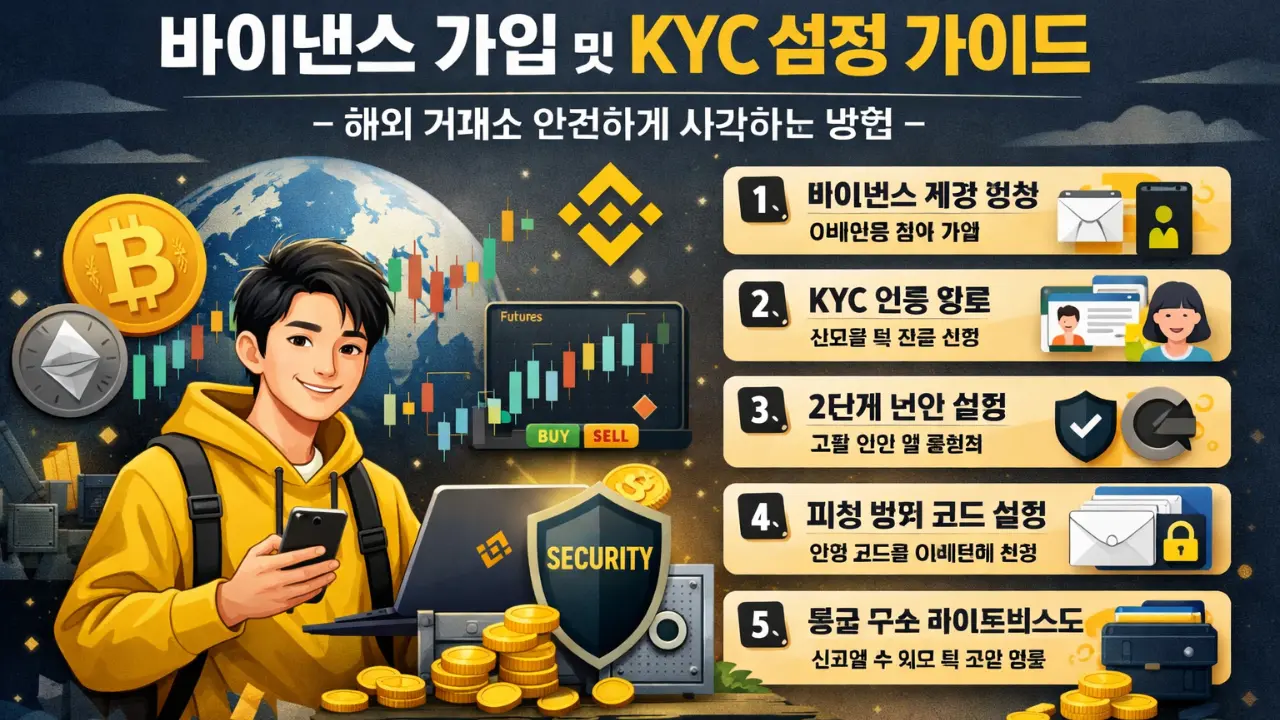
The global cryptocurrency market continues to expand rapidly, and Korean traders are increasingly participating in international exchanges to access spot and futures markets. Among these platforms, Binance stands out as one of the largest exchanges in the world by trading volume. For users in South Korea who want to trade cryptocurrencies, futures contracts, and explore advanced tools, understanding how to register properly and complete KYC (Know Your Customer) verification is essential.
As highlighted by CoinGosu, South Korea’s premier cryptocurrency exchange and futures information hub, security and regulatory compliance are critical when choosing and using any exchange. This guide explains step-by-step how to sign up for Binance and set up KYC security, with practical advice tailored to Korean users.
Why Binance Is Popular Among Korean Traders
Although South Korea has strong domestic exchanges, many traders look to global platforms for deeper liquidity, a wider selection of altcoins, and advanced futures trading tools. Binance offers spot trading, margin trading, perpetual futures, options, staking, and launchpad participation.
For Korean traders who follow insights from CoinGosu, Binance is particularly attractive because of:
- High liquidity in BTC and ETH pairs
- Extensive USDT futures markets
- Competitive trading fees
- Advanced charting tools
- Strong security infrastructure
However, before accessing these features, users must complete registration and identity verification.
Step 1: Creating a Binance Account
To begin, visit the official Binance website. Always verify that you are using the correct domain to avoid phishing attempts. Bookmark the site once confirmed.
Click on the “Sign Up” button. You can register using:
- Email address
- Mobile phone number
For Korean users, email registration is often preferred for easier account recovery and international access.
During registration:
- Enter your email address.
- Create a strong password (at least 8 characters, including uppercase, lowercase, and numbers).
- Enter a referral code if you have one.
- Accept the terms and conditions.
After submission, Binance will send a verification code to your email. Enter this code to activate your account.
Many Korean guides such as 바이낸스 가입 tutorials explain this process in Korean for beginners who may be new to global exchanges.
Step 2: Completing Identity Verification (KYC)
KYC is mandatory for full access to trading, deposits, withdrawals, and futures features. Without KYC, your account will have significant restrictions.
To complete KYC:
- Log into your account.
- Go to “Identification” or “Verify.”
- Select your country of residence (South Korea if applicable).
- Enter personal information exactly as it appears on your ID.
You will need to upload:
- A government-issued ID (passport or national ID card)
- A selfie or live facial verification
Ensure the following:
- Images are clear and not cropped.
- Lighting is good.
- No glare or obstruction on the ID.
Verification usually takes minutes to a few hours. In rare cases, it may take longer if manual review is required.
As emphasized by CoinGosu, KYC not only ensures compliance with regulations but also enhances account security and increases withdrawal limits.
Step 3: Enabling Two-Factor Authentication (2FA)
After KYC approval, the most important step is activating security features.
Binance supports:
- Google Authenticator
- SMS authentication
- Email verification
- Hardware security keys
For maximum protection, Korean traders are strongly advised to enable Google Authenticator rather than relying solely on SMS.
To enable Google Authenticator:
- Download Google Authenticator on your smartphone.
- Go to “Security” settings in Binance.
- Select “Authenticator App.”
- Scan the QR code provided.
- Enter the 6-digit code from the app to confirm activation.
Write down the backup key and store it offline. If you lose your phone without the backup key, account recovery becomes complicated.
Security-focused platforms like auseinet.com often highlight that 2FA is non-negotiable for serious traders.
Step 4: Setting Anti-Phishing Code
Phishing attacks are common in the cryptocurrency space. Binance provides an anti-phishing code feature.
You can create a custom code that will appear in all official Binance emails sent to you. If an email claiming to be from Binance does not include your anti-phishing code, it is likely fraudulent.
To activate:
- Go to “Security.”
- Click “Anti-Phishing Code.”
- Set a unique phrase.
This small step significantly reduces the risk of falling victim to fake email scams.
Step 5: Withdrawal Address Whitelisting
For users trading large amounts or using futures actively, enabling withdrawal whitelist protection is strongly recommended.
With this feature:
- Funds can only be withdrawn to pre-approved wallet addresses.
- Even if your account is compromised, attackers cannot redirect funds to unknown wallets.
To activate:
- Go to “Security.”
- Enable “Withdrawal Whitelist.”
- Add trusted wallet addresses.
This is particularly important for professional traders following futures strategies on Binance or other exchanges such as Bybit or Huobi Global.
Understanding Futures Access After KYC
Once KYC is complete and security settings are enabled, you can activate futures trading.
Steps:
- Navigate to “Futures.”
- Complete the risk acknowledgment quiz.
- Transfer funds from your spot wallet to your futures wallet.
Korean traders should be aware that futures trading carries significant risk due to leverage. CoinGosu frequently emphasizes proper risk management, including:
- Using stop-loss orders
- Avoiding excessive leverage
- Diversifying strategies
Never treat futures trading as guaranteed income.
Common Mistakes Korean Users Should Avoid
Many beginners make avoidable errors during registration and KYC setup.
- Using weak passwords.
- Skipping 2FA activation.
- Not backing up authenticator recovery codes.
- Clicking on suspicious email links.
- Attempting to bypass KYC rules.
Global exchanges strictly enforce compliance standards. Attempting to manipulate verification may lead to permanent account suspension.
Guides from 바이낸스 가입 communities consistently recommend full transparency during identity verification.
Comparing Binance With Other Exchanges
While Binance is dominant globally, Korean traders also explore other platforms such as Bybit and Huobi Global for derivatives trading.
Key differences often include:
- Fee structures
- Available leverage
- Coin listings
- User interface
- Regulatory policies
CoinGosu regularly provides comparative insights so traders can choose the platform best aligned with their strategies.
Regardless of the exchange, KYC and security setup procedures follow similar principles: identity verification, 2FA activation, and withdrawal protection.
Final Thoughts for Korean Cryptocurrency Traders
Signing up for Binance and completing KYC is a straightforward process, but security configuration is what truly protects your assets. Registration takes only a few minutes, yet failing to activate advanced protection can expose you to unnecessary risk.
For Korean users entering the global cryptocurrency market, the recommended approach is:
- Register with accurate information.
- Complete full KYC verification.
- Enable Google Authenticator.
- Set anti-phishing codes.
- Activate withdrawal whitelist protection.
By following these steps, you ensure both regulatory compliance and account security.
As consistently emphasized by CoinGosu and trusted crypto resources like auseinet.com, responsible trading begins with proper account setup. Whether you are trading spot markets or engaging in high-leverage futures strategies, your security foundation determines your long-term success.
Cryptocurrency markets are volatile, but disciplined preparation and secure registration practices can give Korean traders the confidence to participate safely in the global digital asset economy.
