
The world depends on satellites more than most people realize. Navigation, banking, communication, weather forecasting, military coordination — all of it runs through orbit. That’s why the space around Earth has quietly turned into one of the most important strategic zones on the planet.
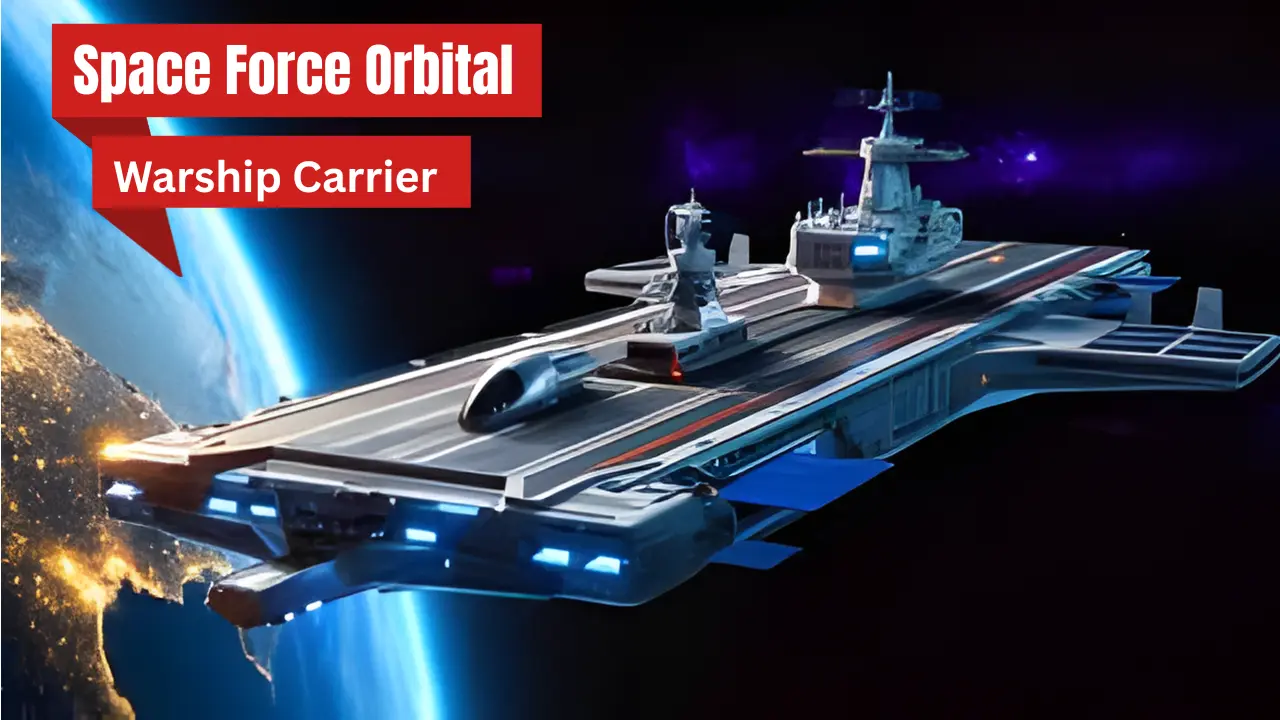
As more nations push into orbit, the idea of a Space Force Orbital Warship Carrier no longer sounds like science fiction. It’s a natural step in a world where satellites are targets, space is crowded, and military dominance includes what happens hundreds of miles above Earth.
This guide breaks down what an orbital warship carrier actually is, why it matters, and how such a platform could reshape global security in the coming decades.
Launch & Assembly: Getting Modules into Orbit
Sending a massive orbital warship carrier into space requires reliable launch technology. Rockets like the SpaceX Falcon 9 have revolutionized how heavy payloads reach orbit, making modular assembly and resupply missions more feasible.
Using such advanced rockets, sections of a carrier can be launched separately and joined in space, ensuring efficient deployment and maintenance.
Understanding the Concept of an Orbital Warship Carrier
What Is a Space Force Orbital Warship Carrier?
An orbital warship carrier is a large, permanently deployed military platform designed to operate in Earth’s orbit. Think of it as a hybrid between:
- a military command center,
- a surveillance hub,
- a defensive shield,
- and a support ship for space operations.
It’s not a “star destroyer.”
It’s more like a fortified space station built with military-grade systems.
Unlike satellites, it can:
- carry crew
- run long-term missions
- deploy drones or probes
- coordinate multiple defense systems
Unlike the ISS, it’s built for security, not science.
And unlike naval carriers, it doesn’t launch fighter jets — it manages space operations.
Why Militaries Are Shifting Toward Space-Based Platforms
For decades, space was treated as a peaceful scientific domain. Today, it’s becoming a competitive military arena.
Here’s why:
- Satellites Are Vulnerable
Countries rely on satellites for everything. Knock out a few, and you can disrupt entire economies. - Attacks Can Happen From Long Range
Cyberattacks, jamming, or kinetic strikes can be launched from Earth or orbit. - Space Has Become a Deterrence Zone
Nations increasingly monitor each other’s satellites and movements. Being “ahead” in orbit is similar to naval dominance in the 1900s.
Historical and Scientific Inspiration
Some real-world programs hint at the direction things are headed:
- The X-37B, a classified robotic spaceplane, shows the U.S. interest in long-duration orbital operations.
- DARPA’s work on robotic satellite servicing demonstrates in-space repair capabilities.
- Modular station research proves large structures can be built in orbit without launching everything at once.
Science fiction didn’t invent the idea — it simply accelerated interest in it.
Strategic Purpose & Mission Objectives
Core Defense Roles
A real-world orbital carrier would focus on missions that enhance national security without violating space treaties:
- Missile warning and tracking
- Protecting high-value satellites from interference
- Monitoring objects in orbit — including debris, foreign spacecraft, and potential threats
- Deterring hostile activity by making space a harder place to attack undetected
Offensive Capabilities (Realistic Only)
International treaties restrict placing weapons of mass destruction in space. For that reason, an orbital carrier would focus on non-destructive, non-escalatory tools, such as:
- Directed-energy systems to blind sensors
- Electronic warfare to block hostile signals
- Cyber tools that disrupt attacks before they escalate
No space bombs or sci-fi railguns — just advanced defense and countermeasures.
Support Missions
A carrier wouldn’t only fight. It would also serve support roles:
- Rescue and recovery if astronauts or satellites encounter trouble
- Orbital logistics, including refueling robotic spacecraft
- Deep-space mission staging, acting as a pit stop
- Emergency communication backup during global outages
This combination makes it part-warship, part-lifeline.
Engineering & Design Architecture
Structural Layout
The design would revolve around safety and modular construction:
- Radiation-hardened hull materials to handle solar storms
- Modular sections for weapons, crew, power, and storage
- Micro-gravity layout, optimized for floating rather than walking
- Shock-resistant layers to contain impacts from microdebris
The body wouldn’t look sleek or aerodynamic. It would resemble a rugged, industrial structure built for function over beauty.
Propulsion Systems
Since it’s already in orbit, the carrier wouldn’t need rocket engines to move around dramatically. Instead, it needs:
- Ion propulsion for slow, efficient repositioning
- Nuclear-electric power for long-duration performance
- Station-keeping thrusters to stay stable against solar pressure and gravity tugs
The goal isn’t speed — it’s stability and longevity.
Habitation & Crew Systems
A long-term orbital platform needs reliable life-support:
- Closed-loop air recycling
- Advanced water purification
- Radiation shielding around living quarters
- Exercise modules to prevent muscle loss
Some designs even explore rotating sections to generate light artificial gravity. This is difficult, but possible on a modular structure.
Launch, Assembly & Maintenance
Such a large carrier can’t be launched in one piece.
Instead:
- Launch in segments via heavy-lift rockets
- Robotic arms handle most assembly
- Maintenance drones inspect and repair the exterior
- Resupply vehicles bring food, fuel, and equipment
Over time, the platform evolves — sections can be replaced or expanded without starting over.
Weapons, Defense Systems, and Onboard Technologies
Defensive Systems
Defense remains the main priority:
- Laser-based shielding to blind incoming sensors or disable small debris
- Debris avoidance systems that predict orbital paths and move accordingly
- Anti-jamming networks to keep communication secure
The goal is to maintain operational readiness in an environment where even a tiny piece of metal can cause serious damage.
Non-Treaty Violating Offensive Tools
Anything destructive risks violating international agreements. Instead, the carrier uses:
- High-precision sensors for tracking hostile actions
- Electronic warfare nodes to disrupt interference
- Directed energy systems designed for defensive countermeasures
These tools help enforce stability without escalating into outright weaponization.
Drones, Probes, and Mini-Ships
A carrier could deploy:
- Recon drones for close satellite inspections
- Repair drones with robotic arms
- Micro-scout craft for missions that don’t require humans
These assets reduce risk and offer more flexibility.
AI and Autonomous Capabilities
AI plays a major role:
- Threat detection algorithms
- Automated rerouting during collision alerts
- Crew assistance systems to manage data loads
- Predictive monitoring for early-warning tasks
AI doesn’t run the carrier — it supports the crew to handle overwhelming amounts of information.
How an Space Force Orbital Warship Carrier Day-to-Day
Mission Planning and Command
The chain of command would include:
- U.S. Space Force controlling operations
- Pentagon oversight for strategy
- Allied partners collaborating on shared security missions
Daily operations look more like running an advanced space station than commanding a naval ship.
Crew Training & Daily Routines
Life aboard such a platform would involve:
- Short sleep cycles to match the 90-minute orbit
- Regular exercise to counter zero-gravity effects
- Constant monitoring of sensors and communications
- Scheduled maintenance across multiple modules
The work is technical, disciplined, and nonstop.
Emergency Protocols
In space, emergencies can’t be ignored:
- Solar flare shields protect against radiation spikes
- Micrometeoroid impact drills prepare the crew for breaches
- Backup communication lines keep signals stable
- Evacuation pods act as last-resort escape routes
Preparedness is more important than combat.
Advantages & Limitations of Orbital Platforms
Key Advantages
- Global coverage, since orbit circles Earth continuously
- Rapid response, spotting missile launches within seconds
- Persistent presence, operating without fuel-intensive logistics
- High vantage point, ideal for surveillance and monitoring
Major Challenges and Risks
- Extremely high cost, from launch to maintenance
- Treaties limiting the use of weapons in space
- Space debris hazards, which grow each year
- Political sensitivity, since militarizing space can escalate global tensions
Ethical & Political Considerations
The debate isn’t about technology — it’s about responsibility.
- Should countries put military platforms in orbit?
- Who owns space?
- How do we prevent escalation?
These questions shape future policy.
How Space Force Orbital Warship Carrier Compare to Other Defense Systems
Orbital Warships vs Ground Missile Defense
| Feature | Orbital Carrier | Ground Defense |
|---|---|---|
| Reaction Time | Faster | Slower |
| Coverage | Global | Regional |
| Cost | High | Moderate |
| Vulnerability | Debris | Missile strikes |
Orbital Carrier vs Naval Carrier
| Feature | Orbital | Naval |
|---|---|---|
| Mobility | Limited | High |
| Mission Type | Space monitoring | Combat deployment |
| Power | Nuclear/solar | Nuclear/diesel |
| Threat Type | Cyber/space | Missiles/ships |
Orbital Carrier vs Space Station
| Feature | Orbital Carrier | Space Station |
|---|---|---|
| Purpose | Defense | Science |
| Systems | Hardened, secure | Civilian-grade |
| Crew | Military | Research |
Real-World Progress Toward Orbital Military Platforms
U.S. Space Force Programs
- X-37B long-duration mission craft
- GEODSS surveillance system
- Counter-jamming technologies improving communication resilience
Other Nations’ Efforts
- China expanding anti-satellite capabilities
- Russia testing orbital inspection vehicles
- India developing space defense programs
Private Sector
Companies like SpaceX, Northrop Grumman, and Boeing push forward:
- Heavy-lift rockets
- In-orbit servicing
- Modular station components
Much of the technology needed already exists — it’s the integration that’s complex.
Future Predictions: 2035–2050
Next-Gen Propulsion
- High-power nuclear-electric systems
- Long-duration ion engines
Autonomous Combat Drones
Robotic craft capable of handling inspections or defensive tasks.
AI-Managed Platforms
AI won’t replace humans but will manage complex operations that exceed human reaction speed.
Multi-Nation Defense Alliances
Joint orbital platforms, similar to NATO but for space.
Practical Takeaways for Interested Readers
Career Paths
- Aerospace engineering
- Cybersecurity
- Astrodynamics
- Robotics and AI
Degrees & Skill Sets
- Mechanical engineering
- Computer science
- Physics
- Satellite operations
How Civilians Can Stay Informed
- Space Force announcements
- NASA updates
- Defense industry briefings
FAQs About Space Force Orbital Warship Carrier
Q1. What is an orbital warship carrier?
A military platform in space for defense, surveillance, and satellite protection.
Q2. Is the Space Force Orbital Warship Carrier building them?
Not fully yet; current programs focus on satellites and long-duration missions.
Q3. What weapons can it use?
Non-destructive tools like lasers, electronic warfare, and sensor-jamming systems.
Q4. How does the crew live on it?
With life-support systems, radiation shielding, and microgravity adaptations.
Q5. Could it replace ground defenses?
It complements, rather than replaces, missile and naval defense systems.
Q6. How expensive is it?
Extremely costly due to launch, construction, and maintenance in orbit.
Conclusion
Space is no longer just a frontier — it’s a growing arena of strategy and defense. An Space Force Orbital Warship Carrier represents a natural evolution of how nations protect their satellites, monitor threats, and ensure stability above Earth.
The technology isn’t fantasy. Most of the components already exist in some form. The real challenge lies in policy, collaboration, and responsible deployment.
What happens in orbit will shape global security for the next century. And platforms like orbital carriers may become the backbone of that future.

1 Comment
Pingback: SpaceX Falcon 9 Rocket Launch | Secrets You Need to Know.